
In Between Stops

Chapter 8
I woke up to a text from The Chef. He wanted to know what I was doing that day. I told him I was on a train heading to Cinque Terre for my sixtieth birthday. Ever since I broke the seal with Sami, I’ve been saying it – sixty – without flinching.
The Chef wrote back, asking when I would be returning because he needed my advice.
I’d met him twice. We’d flirted and talked about his cooking.
When did I go from amore to consigliere?
I love train travel. I don’t read, scroll, or make calls. Instead, I let my mind wander, look at the scenery, and observe my fellow riders. Many revelations have arrived this way, turning these rail adventures into therapy on wheels. For others, like the enormous tour group that infiltrated my cabin, they’re a necessary inconvenience.
Their tour guide was shepherding more than forty elderly folks onto the train, cabin by cabin. She was literally finding seats for them, as if they’d forgotten how to be grown-ups.
She moved like an old-school NYC traffic cop — tracking people, scanning body language, and anticipating needs before anyone even knew they had them.
When the train slowed near the La Spezia Migliarina station, everyone, including me, stood up, ready to disembark.
“No, not here! This isn’t our stop!” shouted the guide as she ran from cabin to cabin.
We all sat back down. I was surprised that I didn’t know it was the wrong stop. Hooray for the tour guide, who looked ready for this trip to end.
I’m very familiar with that vigilant exhaustion. It seems I’ve been on high alert for as long as I can remember.
As a kid, I learned to read a room the way some kids learned to read books.
Who was tense. Who needed diffusing. When to be quiet. When to be funny.
If I helped, I was good.
If I fixed something, I mattered.
I discovered early on that my value came from making things better for others.
But since arriving in Italy, my instinct to fix began to loosen its grip. It wasn’t a conscious decision; the drive was fading on its own, yet somehow the help requests still came from folks like The Chef, whom I barely knew.
As the train’s motion rocked me, I wondered: If I stopped anticipating and fixing things, would I still matter?
I left my budding existential crisis on the train when it stopped in Monterosso, where I’d be staying for the next few days.
The vibrant colors nearly hurt my eyes as I stepped off the platform. The blue sky danced with clouds that floated over the turquoise sea — almost too beautiful to behold.
Cinque Terre has been on my bucket list for years, mostly because it looks too charming to be real. The five villages share the same stretch of coastline, yet each has its own attitude and personality. Everywhere you turn, pastel-colored houses cling to rugged cliffs, tumbling down toward the sparkling Ligurian Sea like a carefully painted postcard.
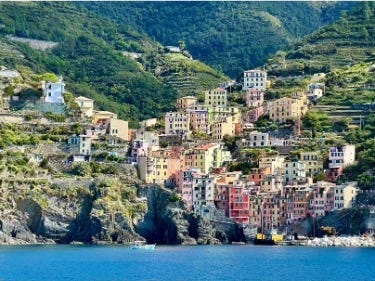
Getting from village to village is part of the adventure. Tourists come just to hike the trails for their breathtaking views, though you can also hop a train through seaside tunnels or take a leisurely ferry along the coast.
I made no plans and did no research because I wanted Cinque Terre to speak to me and drive my decisions. As I waited for the hotel shuttle van, I snapped a selfie and texted it to The Chef with a note: “I will be back in a few days. Let’s plan to discuss your problem.”
He responded. “I love you.”
I missed Sami’s earnest innocence.
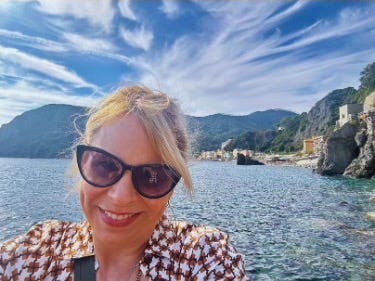
My hotel, La Cabana, was beautiful. Nestled high in the hills, it overlooked the sea, with a line of trees parading along the ridge above. Tamara, the hotel owner, warmly welcomed me and showed me around, where we came upon a group of women on a creativity retreat, painting on the outdoor patio. The place felt like a Bohemian paradise — the perfect setting for a passing decade.
I wanted to treat myself to a special birthday dinner. Tamara suggested the Buranco Winery, close by, and handed me a map. As the sun set, I found myself taking the shortcut path.
The trail was steep — like a roller-coaster dip — which I assumed would eventually even out. Ten minutes later, it was clear the girl who trips on flat surfaces in customs lines had chosen the wrong path: narrow, gravelly, and treacherous.
In loafers.
No lights. No people. No turning back.
Now dark, I forged on — carefully, slowly. My phone’s flashlight illuminated just enough ground to place my feet.
Finally, my brief Yellowjackets episode ended with lights and civilization. I emerged at the back entrance of the winery, unscathed, slightly rattled. A few workers stopped and stared at me, as if I’d appeared out of nowhere.
I was seated at an outdoor table, bathed in warm light among olive trees and grapevines. The seafood tasting menu with wine pairings called to me. I surrendered to it completely.
The plates arrived one by one, and every course felt bright and surprising. The wine made each bite sing. No one glanced at me with pity. I was alone and gloriously irrelevant to everyone but myself.
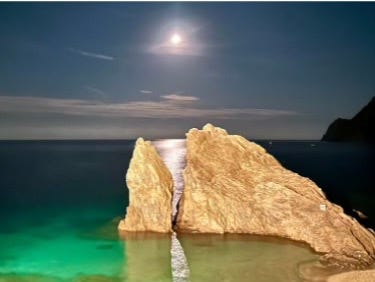
There was no chance I was drunk hiking back up that path, so I headed down toward the beach instead. Locals say the Ligurian Sea steals things from you yet gives something back in its own unpredictable exchange. In that moment, whatever the sea had taken felt priceless, because what it returned was unforgettable: giant rocks glowing in the night, cradling the moon’s brilliance as it poured between them—too radiant to be contained.
Breakfast at the hotel the next day came with eggs, focaccia, and free inspiration. From my table, I listened as Amanda, a well-known artist and the guiding spirit of the creativity retreat, explained Mindful Sketching to her students—short spurts of creativity, no perfectionism, and a strict no-judgment policy.
Just let the painting be what it is. The lesson felt specifically meant for me.
From the deck of the ferry, I watched the colorful villages appear one by one. The ride was calm and unhurried, and I let it be.
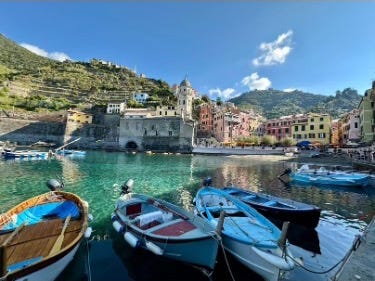
I stopped in Vernazza and Riomaggiore for seafood, cocktails, and a little wandering with no agenda. Cinque Terre was even more amazing than I ever imagined, and I was delighted to be amazed.
The next morning, I turned sixty, and it was time to return to reality. I waited for the shuttle van with Amanda, a few of her students, and a Dutch couple with whom I instantly bonded. Talk turned to Lucca, and suddenly everyone wanted tips and suggestions. I reached for my carefully curated list of things to do on my iPhone, but the Face ID failed.
I tried again. And again. Nothing. I was invisible.
My phone, it seemed, wasn’t ready to embrace a new me.
“I swear this worked when I was fifty-nine,” I said. “What the hell happened to my face overnight?”
Everyone laughed and wished me a happy birthday.
In the van, the phone still didn’t recognize me. I could have turned it off and on, reset it, forced it to work. But I didn’t. I was enjoying the company and my last lingering looks at heaven on earth.
Amanda texted a few days later. I was surprised. I hadn’t really thought I’d made an impact.
She asked if I’d like to meet for a late lunch with her partner, Charlie, and two sisters from the creativity retreat. I suggested Trattoria Da Ubaldo — the restaurant with the avant-garde penis decor. I’d wanted to dine there since discovering it on my Be Bold Day months ago.
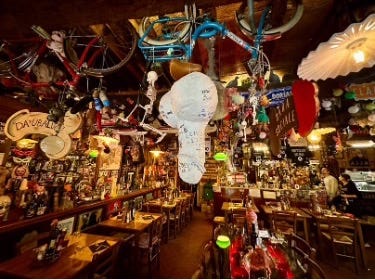
We sat outside, laughing, drinking wine, and lingering over tordelli lucchesi — Lucca’s traditional meat-stuffed pasta.
And then, out of the corner of my eye, I saw him.
Mario.
I’d been curious about Mario ever since the day I sat in The Chef’s restaurant and he swept in, kissing the hostess like it was his job.
“Maaaario,” our server called.
But this was no kissing drive-by. Our server softened when she saw him, wrapping him in a hug and kissing his cheek with real affection.
Mario disappeared inside the restaurant, giving me a chance to grill the server.
“I’ve been trying to find someone to translate for me,” I said. “I’m so curious about Mario. Do you know his story?”
Her expression changed as if she were talking about her beloved grandfather.
“Oh yes. Poor Mario,” she said gently. “He is very sad.”
She told us he was seventy-five, a lifelong Lucchese who lived with his twin brothers. He’d had sisters and another brother, but they’d all passed away. He never married.
Mario roams the streets every day. Everyone knows him. He’s woven into the city’s fabric.
“He comes here every day,” she said. “Sometimes to eat. Sometimes just to use the bathroom. He’s family. We love Mario.”
Mario returned to the table. Our server introduced us and mentioned that I’d been wanting to know more about him. He looked at me, smiled — and then did the unexpected.
He broke into song.
Normally, I would’ve reached for my phone. But I didn’t. I stayed exactly where I was, letting the moment be enough.
Then he kissed me on the cheek.
My very own Mario baci!
I watched as he walked away, waving to shopkeepers and locals amid a chorus of “Ciao, Mario.”
I ached to know more. Why was he sad? But the restaurant was busy, and our server had to rush off. To my surprise, Amanda had recorded Mario singing!
What a blessing.
And so was Mario. Seems he’s the gift that keeps on giving to me, and he doesn’t even know it.
I knew then that I didn’t want to be the fixer anymore. I wanted to just be. And for the first time, that felt like enough.
P.S. Here’s a short video from Cinque Terre — moments meant to be felt.
Favoloso! (I hope that is correct) I would love to go back and see this part of Italy.
Loved this! You're killing me with the chef storyline!